Warehouse automation consulting answers one question before you spend: which system will pay back in your building, with your orders? Our warehouse automation consultants start from your order lines, SKUs and floor, compare the options that fit, and put cost and payback next to each. Then the same team designs and installs the system and tests its rate before you sign off. Lenokers provides warehouse automation services from Portland for operations across Oregon, Washington, California and beyond, and the first site visit is free.
What a warehouse automation consultant does
A warehouse automation consultant, sometimes called a material handling consultant, turns the way your warehouse works today into a decision you can defend. The work runs in order: read your order and SKU data and watch the floor; find which processes are worth automating; match the systems that fit; build a business case on your own volumes; draw the chosen system into your building with the rate it must reach. With Lenokers it does not stop at a recommendation. Our material handling consultants hand the design straight to the team that installs it, so the system you approved is the system you get, and it is rate-tested before go-live.
Levels of automation: from manual to a fully automated warehouse
What is warehouse automation? Any equipment or software that takes walking, lifting, searching or sorting off people. It comes in levels, and most operations climb them one step at a time. Manual, done better: re-slotting fast movers, better pick paths and pick lists; no machines, often the quickest payback. Mechanised: conveyors, carton flow, vertical conveyors and mezzanines move goods so people carry less and walk less. Semi-automated: pick-to-light, VLMs, pallet shuttles and AMRs do the travelling and searching while people pick. Fully automated warehouse: stacker cranes, shuttle storage and goods-to-person robots store and retrieve without anyone in the aisle; people work at stations.
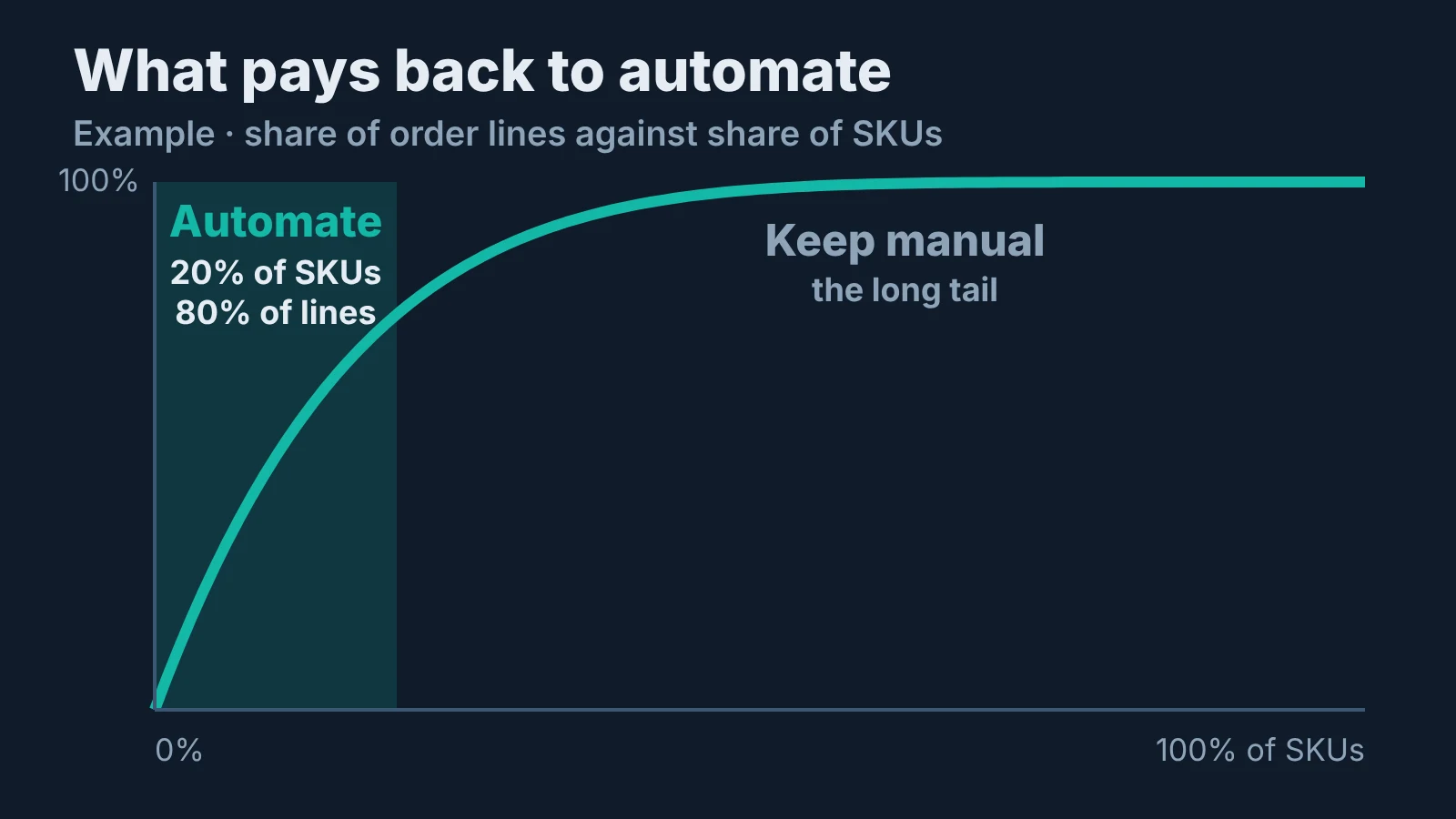
The right level is the one your volumes pay for. Many companies automate warehousing in stages, starting with the process that costs the most hours today and adding the next level when volume justifies it.
How each warehouse automation system works
Warehouse automation systems are easier to judge when you see them run. Each loop below shows one of the automated warehouse systems we design and install, working at real dimensions and real speeds, with what it fits and what to watch for.
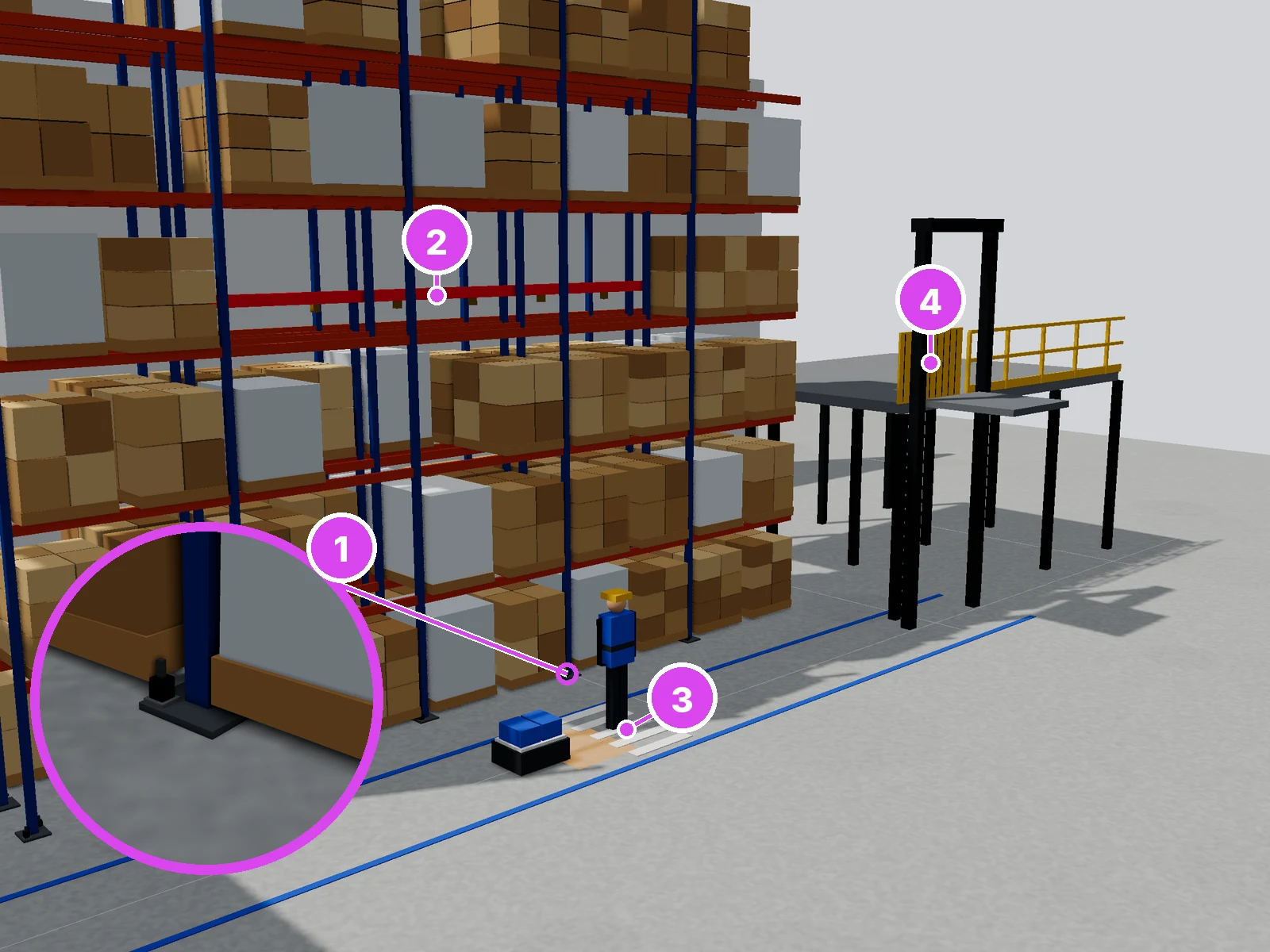
Pallet shuttle. A forklift sets the pallet at the front of a deep storage lane. A battery shuttle runs under it on the rails, lifts it slightly, carries it to the deepest free position and comes back for the next. Many pallets of the same SKU fit in one block with no forklift aisles between them.
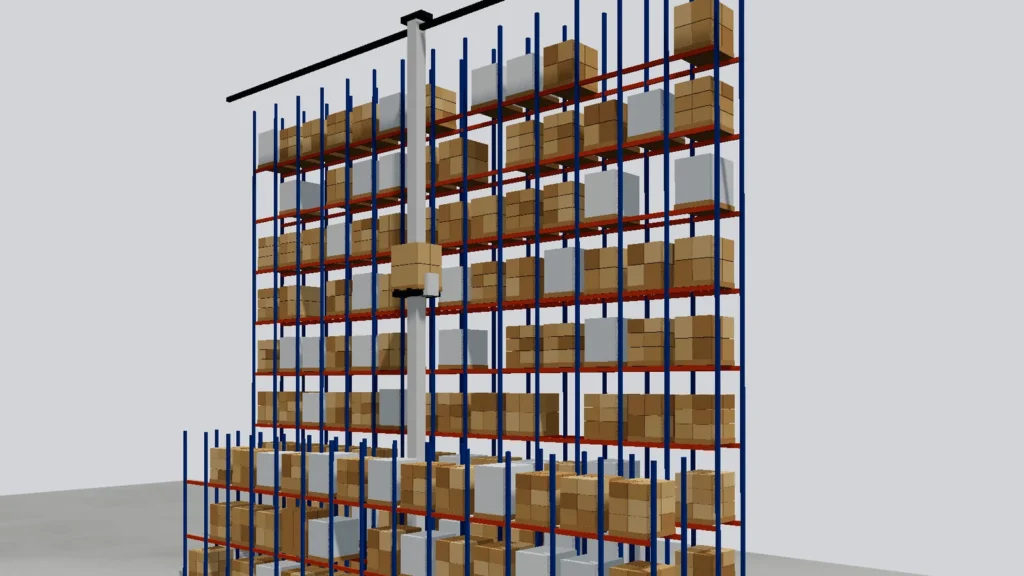
Stacker-crane AS/RS. An automated storage and retrieval system for pallets. A crane runs on a floor rail in a narrow aisle, travelling and lifting at the same time, and puts each pallet into a rack many levels high; it brings pallets back out to a pick-up station at the end of the aisle. Nobody works in the aisle, so it can be as tall as the building allows.
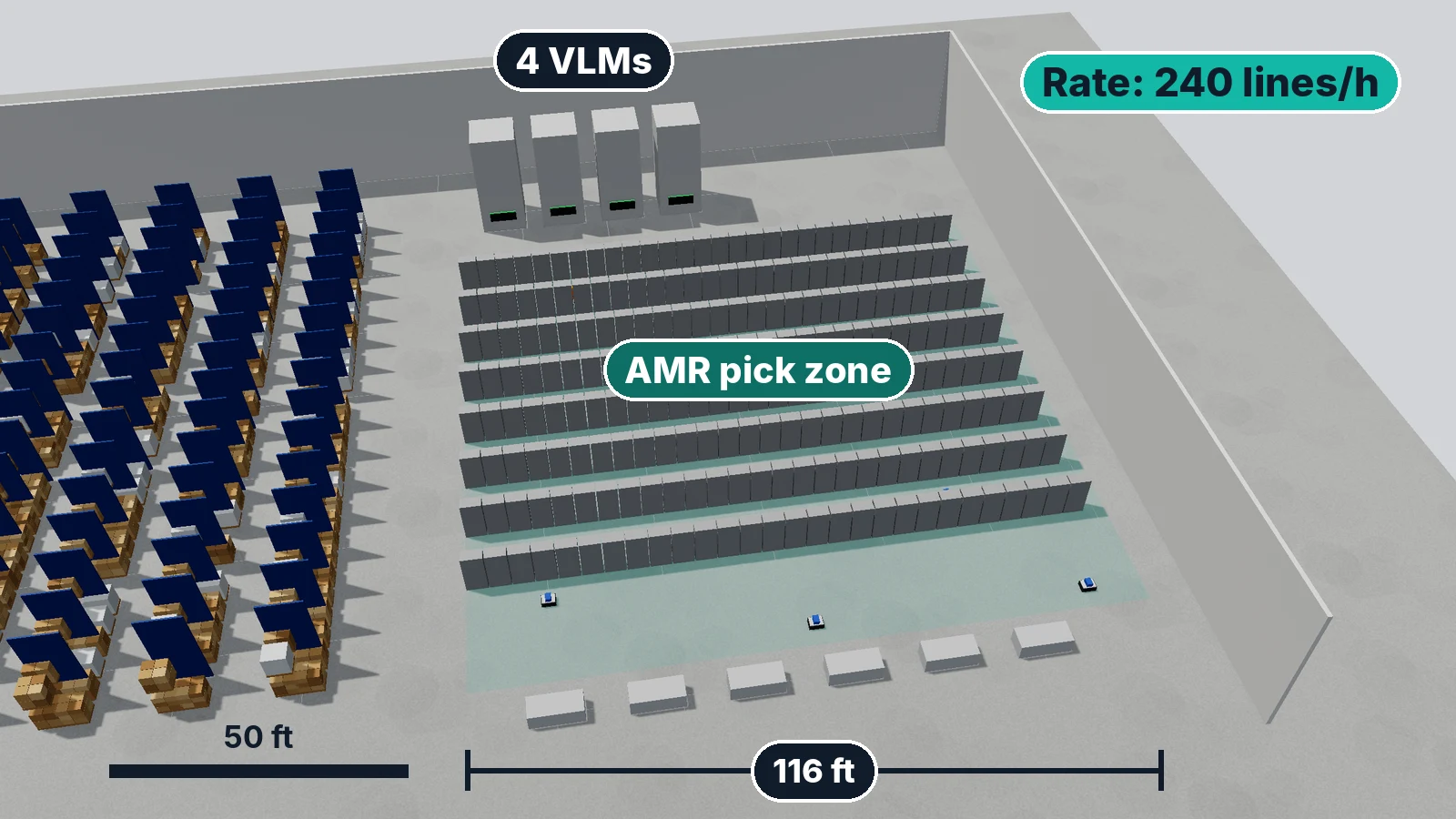
Vertical lift module (VLM). A tall enclosed cabinet with trays stored front and back. On request, a lift in the middle pulls the right tray and brings it to a waist-high opening, where a light points to the item. Small parts that filled rows of shelving move into a few cabinets, and the picker stops searching.
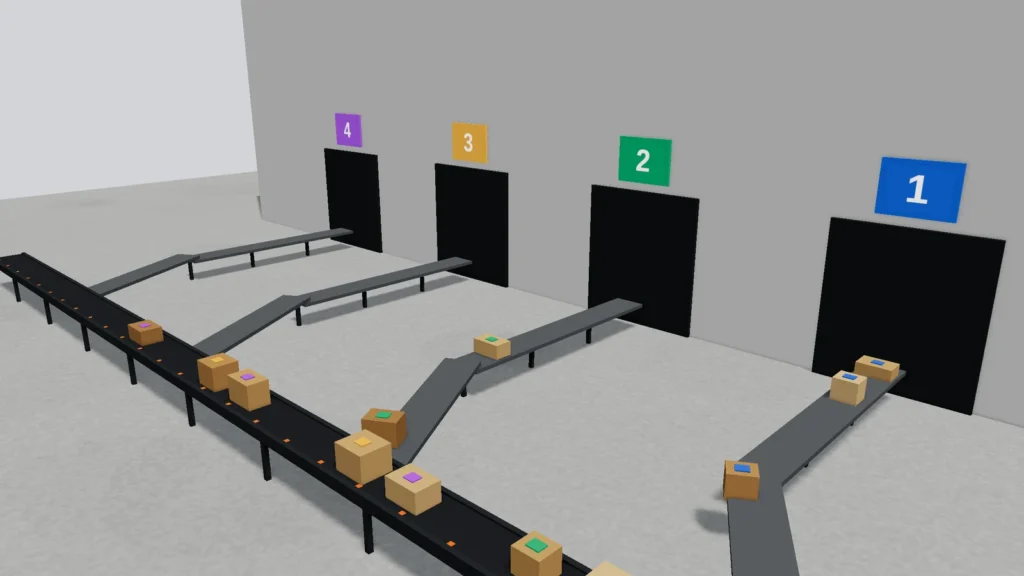
Conveyors and sortation. Belt and roller conveyors carry cartons from picking and packing past a scanner; a sorter reads each label and pushes the carton onto the lane for its dock door. Shipping stops depending on people walking cartons to the right trailer.
Vertical conveyor (VRC). A lift for goods, not people, that moves pallets and carts between the floor and a mezzanine. Gates at every level open only when the carriage is there, so a mezzanine gets used for storage or picking without forklifts on stairs or ramps.
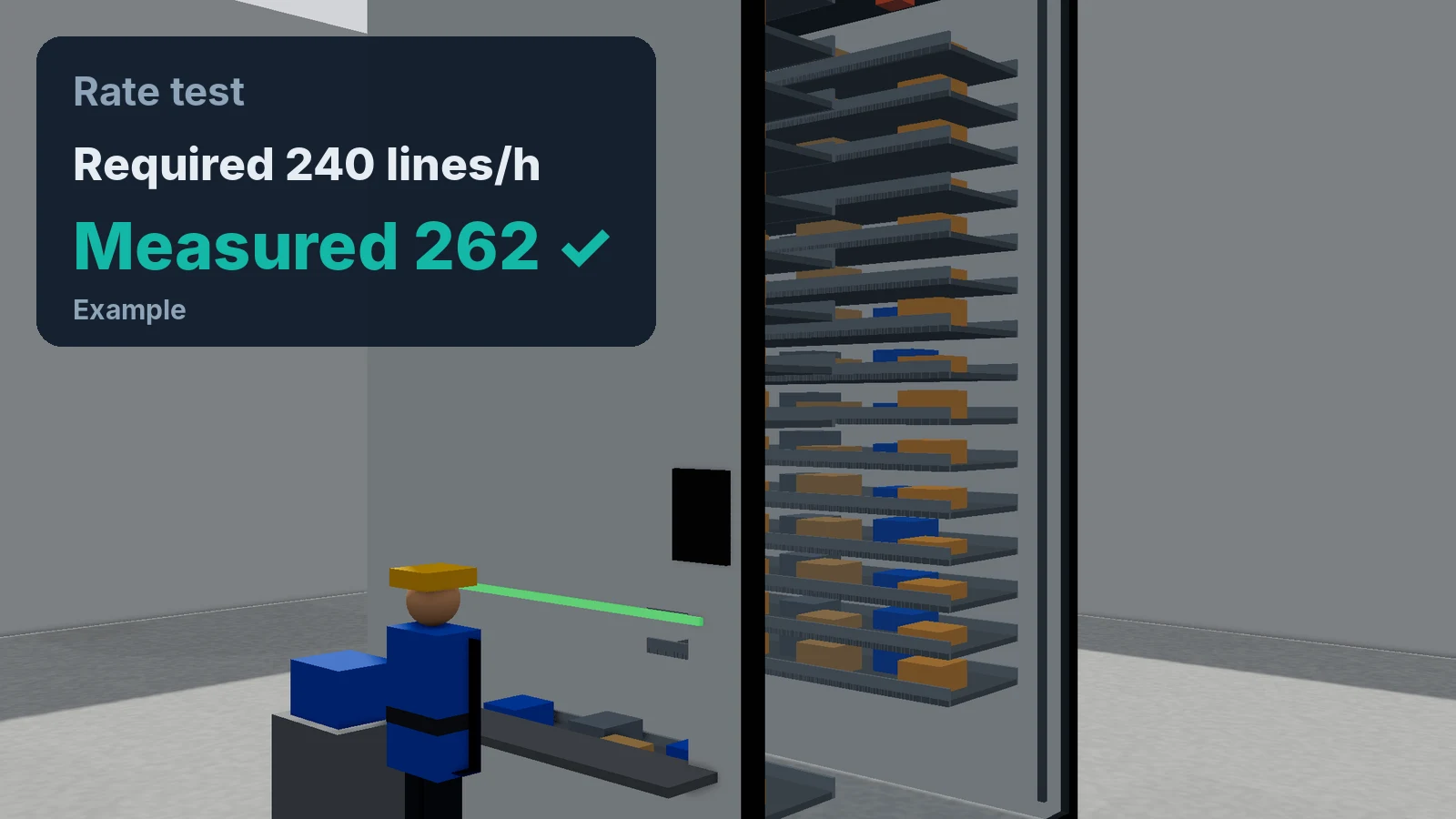
Pick module with pick-to-light. Carton-flow racks on two levels, a tote conveyor running past them. When a tote arrives in a zone, lights show which locations to pick from and how many; the picker picks, presses the light, and the tote moves on. Pickers stay in their zone and the conveyor does the walking.
AMR pick-assist. Autonomous mobile robots carry totes from pick to pick and on to packing, while each picker stays in one area. They find their own way and slow down or stop when a person crosses.
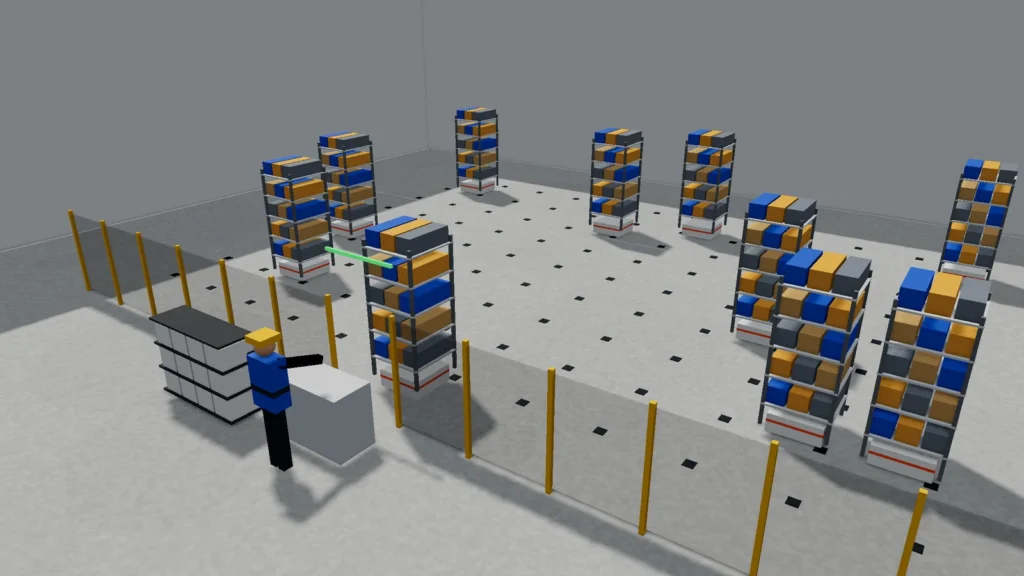
Goods-to-person robots. Low robots drive under shelf pods, lift them and bring them to a station at the edge of a fenced zone. The station lights the shelf face; the operator picks into a put wall; the robot takes the pod back. The operator walks almost nothing, and the shelves come to them.
Equipment names are named as they are in the industry, so this works as a short guide to warehouse automation equipment as well as a picture of what we build.
Warehouse robotics: AMRs, AGVs and robot picking
Warehouse robotics has moved from fixed tracks to robots that find their own way. AGVs (automated guided vehicles) follow a fixed path, such as tape, magnets or reflectors, and stop when something is in the way; they suit repeat moves like pallets from the line to the dock. AMRs (autonomous mobile robots) build a map of the building, plan their own route and drive around obstacles; they suit picking, where the next stop changes every minute. Warehouse robots work in two ways: pick-assist, where AMRs travel with totes and people pick, and goods-to-person, where robots bring the shelf to a person at a station. Robotic warehouse automation works best where people and robots have clear rules: marked crossings, set speeds and zones a robot does not enter. Robotic arms picking single items are growing too, mostly at fixed stations with a narrow range of products.
Warehouse automation companies and integrators: one team, start to finish
Search for warehouse automation companies and you meet three kinds: equipment makers, who build one line of machines; warehouse automation integrators, who combine several into a system; and consultants, who advise and then hand the job to someone else. Lists of top warehouse automation companies rank them by size, but size doesn’t tell you who will make your system hit its rate.
Lenokers works as one warehouse automation company from the first visit to a running system. Our team plans the material handling automation solution, chooses the equipment that fits your operation from the suppliers we work with, designs it into your building and installs it: shuttle racking, mezzanines, conveyors, vertical conveyors and everything else the system needs. One company is answerable for the plan, the timeline and the rate, and when the system is tested, it is tested against what was agreed. In intralogistics automation, the costly problems sit where one supplier’s scope ends and the next one’s begins; with one team, there is no such seam.
Warehouse automation cost and ROI
Warehouse automation cost is set less by the robots than by the whole system around them: equipment (racking, shuttles, cranes, conveyors, robots or VLMs); controls and software (the system that runs the equipment and its link to your WMS or ERP); installation and the building (assembly, power, floor, sprinklers, permits and anchoring); and running costs (maintenance, spare parts, software support and training).
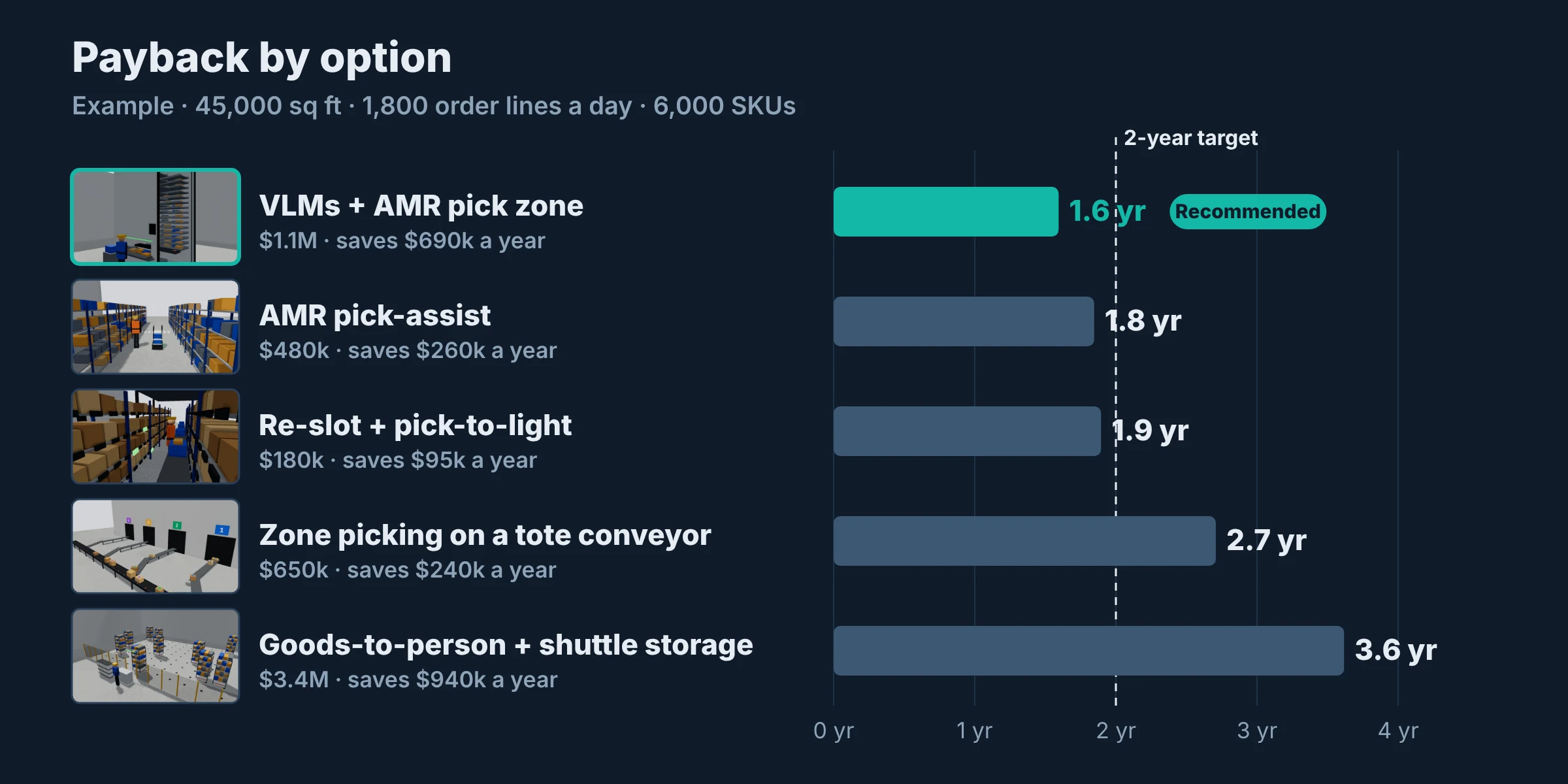
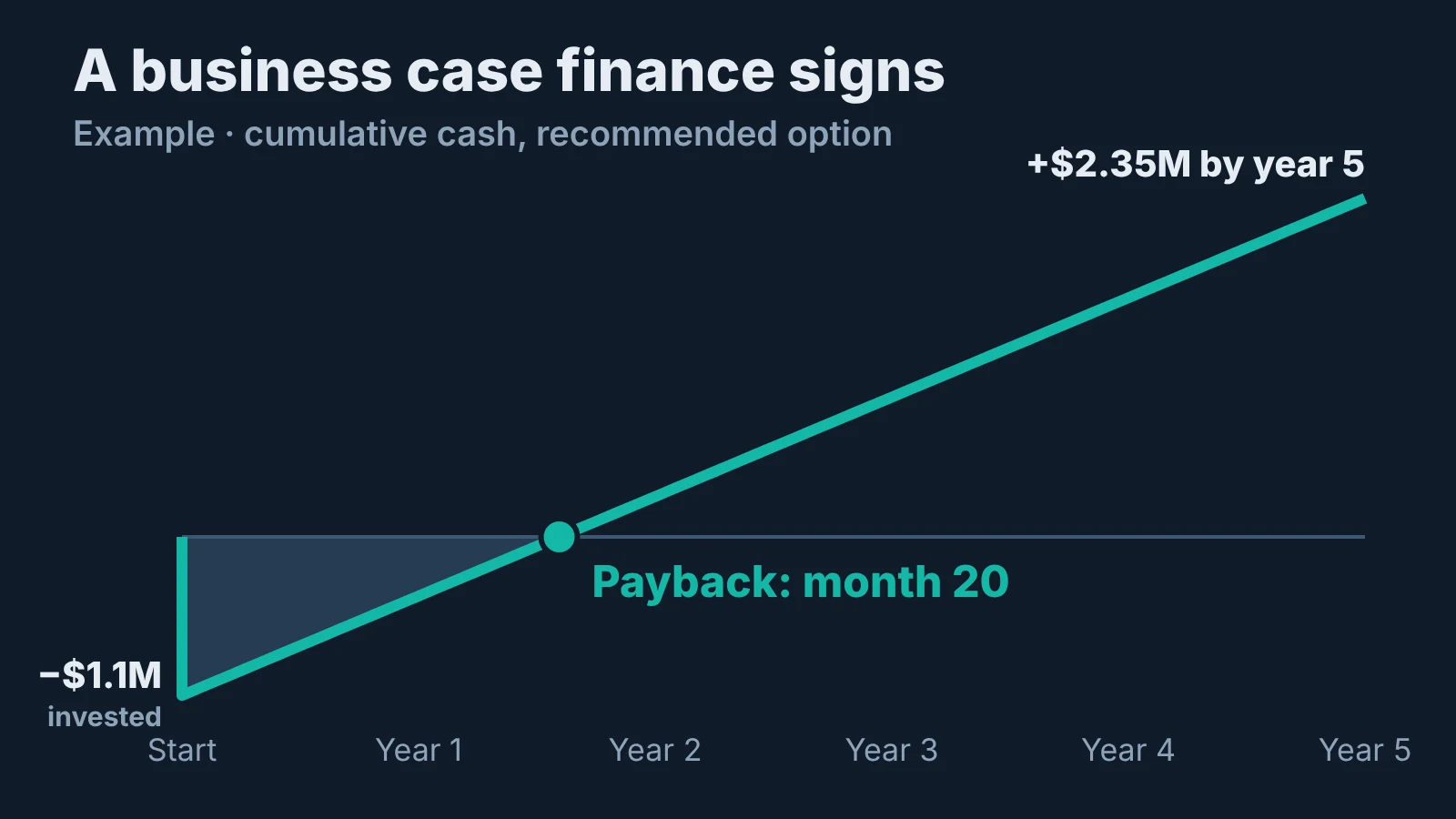
Warehouse automation ROI comes from fewer hours walked and searched, fewer errors, more orders out at peak without extra shifts, and space you don’t have to lease. Payback is the investment divided by the yearly saving. For example, a system costing $450,000 that saves $300,000 a year pays back in a year and a half. That’s why the business case scores every option the same way, on your own volumes, and why the cheapest system that reaches the rate often wins.
Automation for small warehouses
Small warehouse automation rarely means a high-bay AS/RS. It means the one step that removes the biggest cost: a VLM that turns rows of shelving into one cabinet, a pick-to-light zone for the fast movers, a few AMRs taking the walking out of picking, or a vertical conveyor that opens a mezzanine. Each can start small and grow with volume, and each is scored on the same payback as a large system, so a smaller operation pays only for what pays back.
Before you buy: fix the process, then prove it in a model
Automating a slow process makes it slow faster. Order fulfillment automation pays back best when the process under it is right first, so many projects start with a warehouse efficiency audit that finds where the hours go. Before a large investment, 3D warehouse simulation runs the chosen system on your real orders to prove it reaches the rate. If the question is bigger than one system, such as planning a new building, a move or your wider logistics and supply chain automation, logistics consulting plans the whole operation. All of it belongs to our warehouse optimization services, so fulfillment center automation is planned together with the building it runs in.